
Welcome back to an apparent late-night edition of my blog. It is currently 2:05 am, but nonetheless, here we are. I was sleeping, soundly really, when I had a terrible dream that jolted me from any hope of a good night’s rest. Awful, about spiders. Big spiders. Being crawly. Woke up and just rocked a bit before I got out my computer. I’d tell you all about it but then, that’s not really what we’re here for, is it?
No, in fact, we are here today to talk about something equally as fascinating. Well, not really, I’m sure my dream one-ups this a bit. GOD, even now I keep randomly shuttering whenever I let one of those spiders crawl back into my mind. I hate spiders. Anyway, today we will be talking about light bulbs.
In case you didn’t know, a light bulb is a light powered through electricity, but then again, if you didn’t already know what lightbulbs were, you probably wouldn’t be here. I’ll go into some details anyway.
Before the lightbulb, the world was dark. Well, they had candles and you know, the Sun, but the world was dark. Then, as most people who went to elementary school know, Thomas Edison came along. What you might not know, at least I didn’t, was another man named Sir Joesph Swan also invented a lightbulb around the same time. Not even 25 years later, many people around the world had light. Thanks, guys.
To understand how lightbulbs work, you need to understand how light itself works. It’s pretty simple actually. Light is emitted in the form of a photon, which is released from an atom when the electrons get excited. The electrons can get excited when the atom gains or loses energy, as this is expressed by the movement of the electrons. I’m obviously not going to explain how an atom works in detail, but if you really are clueless, electrons are arranged in orbitals surrounding the nucleus. Generally speaking, the more energy an electron has, the farther it will be from the nucleus. It is best to picture the movements of the electrons using Bohr’s model instead of trying to visualize an electron cloud. When an electron gets excited, it will jump up to the next energy level only for a fraction of a second before being pulled back down. It does this a lot, and these movements produce photons which we observe as light.
Depending on how many photons were released, a different wavelength will be expressed (in simple terms, wavelength determines the color we perceive). Different sorts of atoms release different wavelengths, thus why we have this wonderful array of colors around us on a daily. Unless you’re colorblind, in which case I’m sorry.
The structure of a lightbulb is relatively simple. There are two metal contacts opposing each other at the base which connect the light bulb to an external electrical circuit. Two stiff wires are attached to the bases which are also attached to a thin filament wire in the center of the bulb. A glass mount keeps the filament in place. All of this is housed in a glass bulb filled with an inert gas.
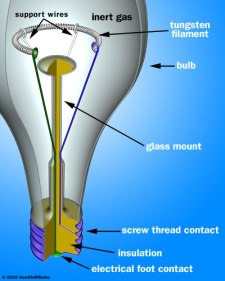
When connected to a power source, energy flows from one contact to another through the wiring and the filament. Free electrons, or electrons that are not tightly bound to a nucleus, flow from one contact to the other due to their opposite charges. On this journey, the electrons bump into other atoms in the filament which creates heat. In other words, it excites the atoms. When an electron releases extra energy by coming back down to its original energy level, a photon is emitted. Since metal atoms usually release infrared light which is invisible to the human eye, they have to be heated to temperatures upwards of 4,000 degrees Fahrenheit in order to emit visible light.
The filament itself is made of tungsten. It is a very long yet incredibly thin strand of metal that is coiled up many times in order to fit in the lightbulb. Tungsten is used in practically all incandescent light bulbs because it has a very high melting point and can withstand the very high temperatures I previously mentioned are required for emitting visible light. However, tungsten will catch fire. Which moves us to our next point of why the bulb is filled with an inert gas. On Earth, combustion generally requires oxygen. The glass bulb provides an oxygen-free chamber. An inert gas, typically argon, is added because it was found that in a complete vacuum, the tungsten atoms can actually evaporate due to the high temperatures. The lightbulb would still work, but its life would be shortened considerably. When there is an inert gas filling the space, the tungsten atoms tend to stay in place.
You may have heard of LEDs or fluorescent lights. They are often considered the more energy efficient choice because unlike incandescent bulbs, they do not produce as many unseen infrared protons (only 10% of light emitted from incandescent bulbs is visible). Therefore, LEDs and fluorescent lights have come to bear the name, cool lights – they give off mostly visible light.
One more thing: You may have heard this fancy technical term before: watts. Watts are simply what is used to measure the amount of light emitted in a certain amount of time. Higher watt light bulbs produce more light.
That’s all.
This wonderful distraction has been very useful to me, which kind of juxtaposes the whole point of this blog. It wasn’t the information that was helpful, just that it diverted my mind from the whole spider thing. So I guess the integrity of the uselessness of my blog remains intact since the information itself isn’t exactly need-to-know. Though, I guess understanding how lightbulbs work could be considered important. Though, so could differentiating fabrics depending on your priorities. I’m going to stop typing before I venture further into questioning the validity of my blog.
 A Blog